



Follow Kritica on Google
Add Kritica to your favourite sources.
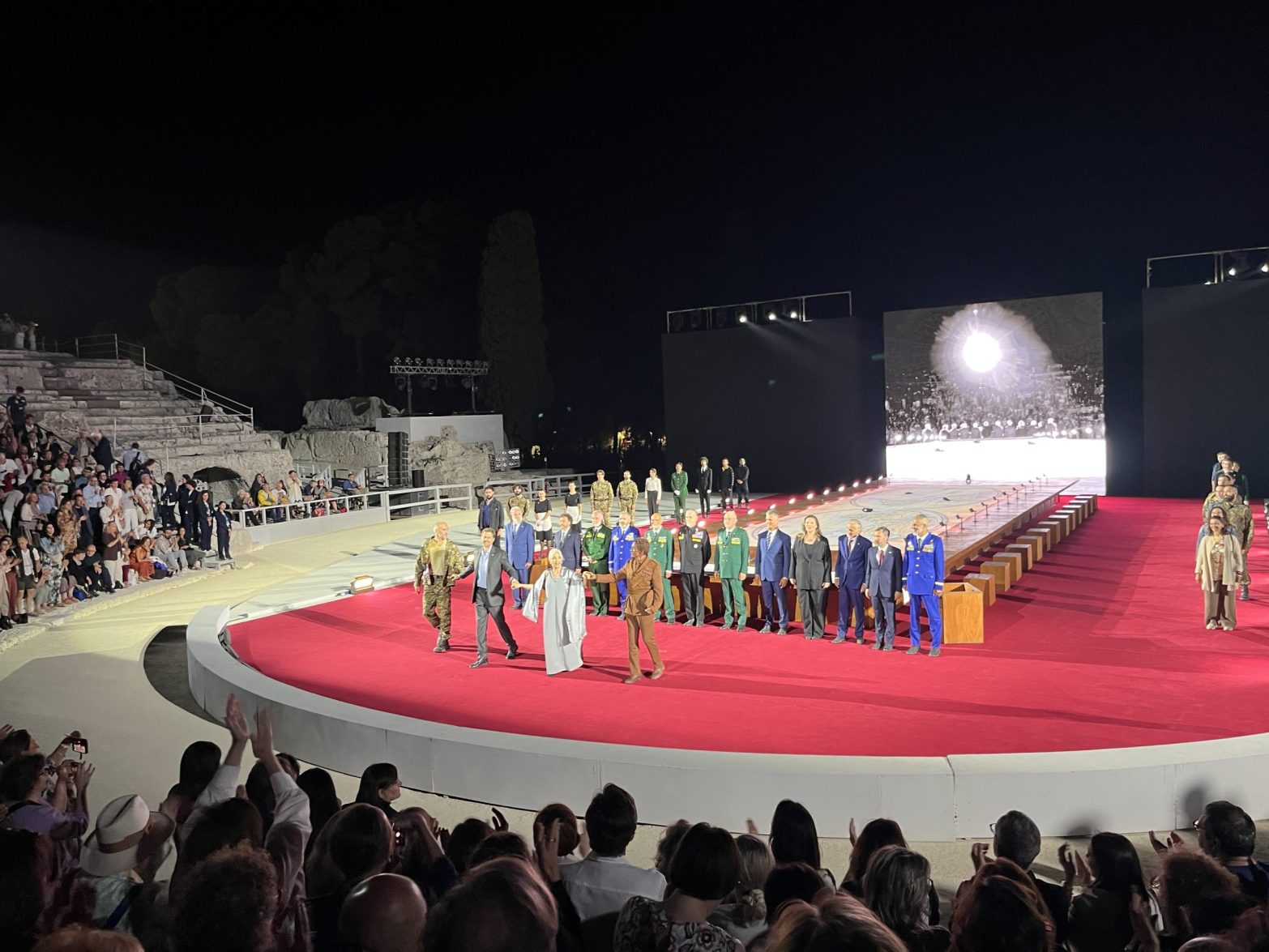
The representation of Greek tragedy in the classical age was a moment of reflection for the police – One moment Politician par excellence. This is the dimension that the Catalan director Àlex Ollé has most wanted to preserve in his contemporary reinterpretation of The Persians in Aeschylus, first performed at Greek Theatre of Syracuse, on 13 June 2026. Her Persian They are indeed the mirror of the Western imperial frenzy seeking to halt the decline of its supremacy, magnifying war – in its contemporary technological and technocratic monstrosity – as an ineluctable and all-encompassing condition of contemporary societies. The tragedy opens with a frenetic military gathering under a giant screen, which throughout the tragedy will repeatedly amplify the most atrocious expressions of the protagonists.
In the scenario of a thousand-year-old theatre, those Persians we are we, the living of today: the director's vision is made explicit by a set dropped into today's world. No golden chalices and purple drapes. Just a huge war room table and generals in uniform.
Ollé's ambition, to re-politicise contemporaneity
Ollé's choices did not disappoint those who, like myself, had gone to see The Persians precisely to test the political responsibility of a director who today brings onto the stage a rivalry – that between Persians and Athenians – of a most current symbolic and historical scope. Other spectators, according to local press reports, have instead complained about the absence of antique-style scenography.
This desire for the antique could easily be mistaken for classicist worship. In truth, it reflects the spirit of the times very well; we are in a historical moment when art is required to have a purely commercial, ahistorical – or anti-historical – and above all Apolitical, as if the role of art were divorced from society and were, in fact, precisely to not disturb the monstrosity of the power politico. Especially as the latter forces us to be spectators of an ostentatious and theatricalised genocide, the genocide that Israel is committing against the Palestinian people, with the crucial support of almost all Western governments: an anti-nomos which becomes nomos on the scene of reality.
It is precisely for this reason that it is necessary to grasp the historical and symbolic significance of the staging of The Persians In Syracuse. Àlex Ollé has at once honoured and subverted the long Western reception of the work that Aeschylus staged at the Dionysia in 472 BC. The Persians I am the drama that most exemplarily, among the tragedies that have come down to us, stages the Hybris imperial, highlighting the lament of the Persian people and of Atossa (masterfully interpreted on stage by Anna Bonaiuto), mother of King Xerxes, who had led his fleet to defeat at Salamis in 480 BC in an attempt to subjugate the city-states Greco, to expand an empire that already dominated much of Asia and extended as far as Ionia.
The Persian Empire, model and nemesis of the West
From the eighteenth century onwards, the view of the Persian Empire – through The Persians of Aeschylus and the Xenopedia of Xenophon – acquired a specific function in the Western imagination. How did Hamid Dabashi write, Persia became the model for European colonial ambition and, at the same time, its nemesis, while paradoxically the’imperialism The European sought to reconstruct a millennia-long historical continuity – along the lines of the Persian one – by artificially tracing its origins to the ancient imperial glory of Athens, exalting the local history of Greece, a peripheral area of modern Europe with no historical ties to Paris, London, Berlin, or other imperial capitals.
The long legacy of this mimesis today takes on grotesque and sinister tones, as the United States empire, steered by Israel's regional ambitions, contemplates its destruction. alter ego strategic, the’Iran, but discovers in the Strait of Hormuz, just as the Persians did at Salamis, the limits of their imperial dominion. Today Salamina is located in Hormuz.
Àlex Ollé could not have predicted leading I Persian taking place at the same time as the historical humiliation the United States brought upon itself – attacking Iran in its hubris and hoping to catch a well-prepared enemy unawares – but it certainly had in mind the ideological backdrop of imperialist anxiety that fuelled the expedition.
The war at all costs waged by the powerful and the popular protest against the war form a dichotomy that underpins the development of the entire tragedy. The drama opens with slogans of a demonstration Against the war sounds heard in the distance, it is composed around the story of the messenger who survived Salamis (Giovanni Sartori, in an exceptional interpretation), and is punctuated by interludes which require the viewer a few seconds to understand that they are not external intrusions, but an integral part of the staging: a war widow, a young cashier, denounces the ‘homeland’ – pure rhetoric – for having taken her husband; a group of protesters from the audience displays a banner with “NO TO WAR” written on it; finally, to close the last act, a mother wanders through the city, searching for a son for whom she doesn't even have a coffin to mourn, while in the background Xerxes and Atossa, after weeping over their defeat, turn the page, enjoying an elegant dinner. A damning finale to remind us all that it is always and only the poor who pay the price of war.
Mentre i sostenitori del rearm They call for the reintroduction of conscription for our children and are already cutting funds to healthcare, education, and research in the name of the coming war. What moves them is not a real enemy on the horizon, but the renewed symbiosis between the military-industrial complex and the expansion of financial capitalism and artificial intelligence, which on Gaza He has just tested his latest “innovations,” ready to generate new profits by extending to other fronts.
Metatheatre and politics offstage
But the metatheatrical dimension of the premiere of I Persian has far surpassed what the script itself foresaw. Greeting the spectators at the entrance to the archaeological park, a demonstration of solidarity with the Palestinian people opened the descent leading to the Greek theatre. Descending towards the semi-circle, a conspicuous and unusual presence of law enforcement (not comparable to other evenings) formed a cordon for the spectators; perhaps there to control the peaceful demonstrators, perhaps to protect much higher ranks.


The guest of honour who was giving interviews in front of the stage before the start was in fact the British actress Helen Mirren, who has distinguished herself in recent weeks for revealing the excitement she felt during a trip to Israel in 1967 when, faced with the Palestinian population driven from their homes, she witnessed the birth of the small European Zionist colony in the heart of the Arab Levant. Flanked by her in great pomp was the mayor of Syracuse, complete with his tricolour sash, elected with the party Action of Carlo Calenda, among the most fervent supporters of rearmament. To anyone in the audience who felt annoyed by such parterre at least the pleasure remains of having seen these distinguished spectators become – unknowingly and against their will – part of the scene, with a very specific role: at least for once forced to observe, without the power to censor or denigrate, a protest that, through theatrical fiction, laid bare all their real Hybris – a real tragedy for the police global, for all of us.
This, moreover, is the function of Greek tragedy which Ollé has faithfully observed: to represent the Conflict tra Hybris e justice (Justice). May it be with the best wishes of those who cannot tolerate that the political soul of art is still alive.
© Kritica – Partial reproduction allowed (no more than half an article) by citing the source and including the link.
PHOTO CREDITS: Marina Calculli