



Follow Kritica on Google
Add Kritica to your favourite sources.
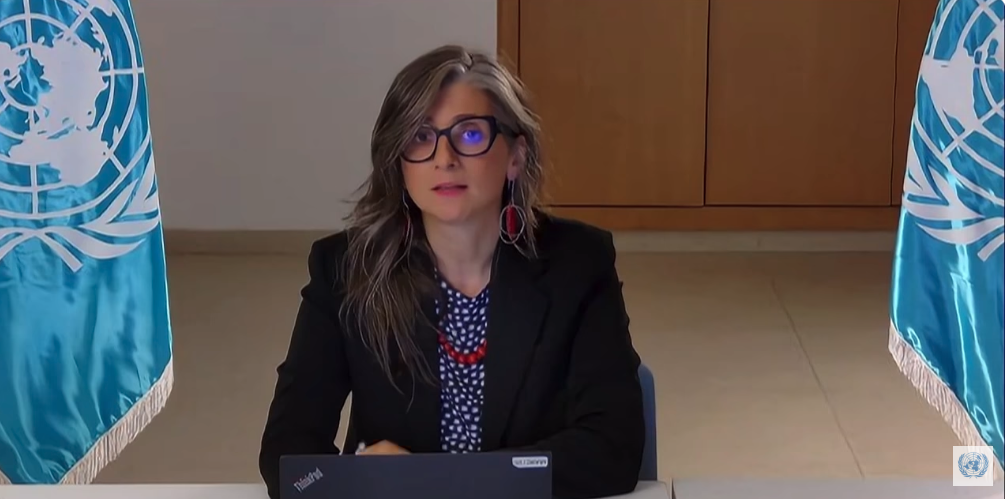
The role of the media in shaping the narrative on the genocide in Gaza, censorship in Israel, and the responsibilities of the international media. An interview with Francesca Albanese, United Nations Special Rapporteur on the situation of human rights in the Occupied Palestinian Territories, about her latest report, The Truth Beneath the Rubble: The Media in the Time of Genocide, that Kritica translated into Italian and made it available to readers for free.
What are the main findings of your work? And what role did the media play in creating the context that facilitated the commission of these crimes?
The Truth Beneath the Rubble: The Media in the Time of Genocide is a report that exposes how the disappearance of the truth—or its manipulation—facilitates the commission of crimes, including genocide. The analysis is divided into three parts.
The first concerns the attack on the Palestinian media, which has led to the killing of nearly 300 journalists and media workers. For 70 of these journalists, investigations have already shown that they were killed because of their work, including in response to threats they had received to stop documenting what was happening. A total of 710 family members of journalists were also killed, in addition to the destruction of 81% of the infrastructure needed to transmit information.
Israel acted this way because targeting journalists means preventing voices from remaining that are capable of reporting on and analyzing what is happening on the ground. Those who were not killed were arrested and detained: 100 Palestinian journalists were arrested and tortured, and 35 of them are still in prison.
The second level of analysis concerns what has happened in Israel. Over the past three years, Israel has acted primarily through censorship, intimidation, manipulation, and incitement to genocide.
Few people know this, because this aspect does not fit into the narrative promoting the so-called “only democracy in the Middle East,” but Israel has an extremely active censorship apparatus. Between 2024 and 2025, it censored, edited, or banned tens of thousands of news stories. Information is also blocked through the gag orders, military orders that criminalize anyone who discusses matters covered by military secrecy. It is a form of censorship, but that is not all: information about Israel itself has also been fabricated and then disseminated as if it were factual news.
Few people know this, because this aspect does not fit into the narrative promoting the so-called “only democracy in the Middle East,” but Israel has an extremely active censorship apparatus.
When people say that Israel writes its own history, that is exactly what it does. Added to this is the role of the political system, amplified by certain segments of the Israeli media, such as Channel 14 and Channel 12, which have incited genocide by describing all Palestinians in Gaza as a cancer to be eradicated, insisting that they are all terrorists, and using other forms of discriminatory language.
Finally, there is the role played by some of the most influential international media outlets, such as the BBC, ABC, The New York Times and Sky News, and platforms such as Meta, Instagram and YouTube, which contributed to and, in some ways, facilitated the genocide and the commission of other crimes. They did so through biased news coverage, the dissemination of false information—such as the report of 40 beheaded children—and the publication of editorials that blamed Hamas for every death in Gaza.
Of course, Hamas bears their own responsibility, but the Palestinians who were killed were killed by Israel. The 75,000 Palestinians killed in Gaza—85% of whom are women and children—and the 21,000 children killed: these people were killed by the Israeli military. Legal or moral responsibility must be attributed to no one other than the apartheid state of Israel.
There was also a downplaying of responsibility: when Palestinians were killed by Israel, it was reported that they “died” or that “buildings collapsed.” A very different kind of empathy was shown toward Israelis—even when they were soldiers—compared to that shown toward Palestinians. The bias in the narrative was evident. The media were given unprecedented space to promote the Israeli military perspective, as rarely seen in recent times. All of this has fueled Israeli propaganda and genocidal propaganda. Investigations must be conducted, and in some cases, the relevant authorities must intervene to determine who, if anyone, is responsible.
When we tell about reality, the choice of words is crucial. Israeli operations are referred to as “raids,” while those carried out by Palestinian groups are called “massacres,” for example. A semantic battle has also developed around the term “genocide.” How important is it—including from a legal standpoint—to describe events using the correct terms? And what recurring patterns have you identified?
The case of the journalists is emblematic because it illustrates what happened to Palestinian civilians: the way they were targeted by the Israeli army, the narrative that fueled this process, and the way they were treated by the international press and in public discourse mainstream, which is also supported by some political circles. From this perspective, Italy is a significant case.
Setting aside the specific words used, I would like to focus on the erosion of international law. International law provides us with a universal language; it helps us bring clarity to turbulent situations such as conflict, military aggression, or civil strife. It allows us to maintain a neutral and objective approach in situations of extreme polarization.
Instead of relying on international law, Italy has relied on ignorant people and charlatans. But even those who are familiar with the reality of the Palestinian situation have struggled to use the word “genocide,” because they do not understand its legal meaning: genocide consists of the intentional destruction—or the intent to destroy—a group as such.
The group in question is the Palestinians. It doesn’t matter whether they are civilians, children, teachers, doctors, or journalists. The concept of protecting civilians in wartime and the principle of distinction have been lost. In a conflict situation, the only way one can be targeted—and I don’t just mean killed, but also arrested—is by being a combatant.
Instead of relying on international law, Italy has relied on ignorant people and charlatans. But even those who are familiar with the reality of the Palestinian situation have struggled to use the word “genocide,” because they do not understand its legal meaning: genocide consists of the intentional destruction—or the intent to destroy—a group as such.
Civilians must never be targeted, whether they are Israeli or Palestinian. Palestinian journalists have been treated as terrorists. Israel has a unit within its military called Legitimization Cell, whose job is to fabricate lies and pass them off as the truth.
That is what happened, for example, with the spread of the kill lists, the hit lists targeting Palestinian journalists, even before they were singled out. The same thing happened when it was claimed that there was a command center beneath Al-Shifa Hospital or that terrorists were hiding in homes and tunnels. Total confusion ensued, which served to facilitate the commission of genocide.
The use of words has been instrumental. But a journalist remains a journalist, and a civilian remains a civilian, as long as they do not take part in hostilities. Even if they spread propaganda—as may be the case with Israeli journalists—or incite others to commit certain acts; incitement to hatred and violence is a crime, but that does not mean taking part in the fighting. Otherwise, Israeli journalists, too, would all have to be considered parties to the conflict. They are not: they are civilians, just as the Palestinian journalists who did their jobs are civilians.
Israel claims that some Palestinian journalists have given a platform to Hamas, interviewed its representatives, or reported on its statements. But this is not terrorism, and in many cases, it didn’t even happen. In countries like Italy, any mention of Hamas has become a free pass to justify any crime. That is the reality.
There has been little scrutiny to determine that specific responsibilities exist. A state that systematically targets journalists, as Israel has done, commits a war crime. If it does so on an ongoing basis and as part of an attack on the civilian population, it may constitute a crime against humanity. The killing of people who enable us to understand what is happening—and, in this case, to document and stop a genocide—may also constitute evidence of genocidal intent.
An investigation should be conducted into the Israeli press for incitement to genocide. In the cases I have identified, there is evidence—a great deal of evidence—that has also been gathered by Israeli journalists. But we also need to scrutinize what the media in the Western world have done.
Just as was the case during the genocides in Rwanda and Bosnia and Herzegovina, when the courts found certain media outlets to be responsible, I believe that in this case as well, some media outlets bear responsibility for having given strength and fuel to the Israeli narrative that condones genocide. It is necessary to determine who is responsible.
I am acutely aware of the delicate, extremely fine line that separates scrutiny of the press’s work from an intervention that could compromise its independence. However, it is necessary to determine individual accountability, holding publishers and columnists accountable. We must understand why certain people acted in that way: out of ideology, racism, or because they were acting on someone else’s behalf.
Just as was the case during the genocides in Rwanda and Bosnia and Herzegovina, when the courts found certain media outlets to be responsible, I believe that in this case as well, some media outlets bear responsibility for having given strength and fuel to the Israeli narrative that condones genocide. It is necessary to determine who is responsible.
There have already been cases brought to court. In Australia, ABC News, the country's leading broadcaster, fired a reporter for reposting a story about the famine published by Human Rights Watch. The broadcaster spent 1.7 million Australian dollars to defend its position, using public funds to defend what I consider to be a lie. The journalist took the matter to court, and the judge ruled that the broadcaster had acted under pressure from pro-Israel groups.
There is, therefore, a form of information corruption in Western democracies. This ties in with what many of us refer to as, the “Israelization” of our societies. This does not mean that Israel controls our societies, but that the logic behind the defense of Israeli apartheid must be understood and studied. Israel has become a model for our Western democracies: security is prioritized, freedom of expression and dissent are sacrificed, profits are placed before rights, and people’s rights—both individual and collective—are sacrificed.
The report also offers a broader reflection on how the manipulation of reality creates a disconnect between what is experienced in Palestine and Israel and what is perceived in the West. This disconnect can create a sense of unreality even among those who engage with the Palestinian issue and wonder what can still be done if there is no longer a shared reality. How do you interpret this disconnect?
I would like people to reflect on the fact that here we are striking at the heart of a system of exploitation and oppression that has been going on in Palestine for a hundred years. In turn, Palestine and the martyrdom of the Palestinians have allowed us to see a phenomenon of exploitation that has existed for hundreds of years. Colonialism has a history spanning half a millennium. Seizing a people’s land and justifying it on religious or civilizational grounds is a practice that runs through our history, right up to the development of the legal framework for human rights.
It’s only been 80 years since we began striving to treat one another decently as human beings. I always say that until around 1960, the Belgians kept people of color in zoos. Until a few decades ago, in Europe, female adultery was punished by stoning, just as it was in Kabul under the Taliban. Just look at photographs of universities from forty years ago: in the West, it was white men who occupied the university seats.
Things are changing; the world has become more democratic and equitable. But every step forward comes with the loss of some privileges. And this loss is inconvenient for those who hold those privileges and want to keep them.
So we are fighting for a system that is more just and humane toward everyone, one that recognizes the rights of peoples, of individuals, of the environment, and of animals. We are fighting for a system that protects the environment in all its dimensions.
To stand in the way of the Israeli system means also standing in the way of the multinational corporate system, the extractive industry, and the banking system—which decides how to strip everyone of every last resource. We are caught up in a hyper-liberal system in which it is no longer possible to impose any rules or limits on profit.
This is what we are up against. Predatory elites, as Amnesty International calls them, hold most of the economic power. It is not just a matter of purchasing power, but of the power to control and shape policy. These elites influence those policies.
Today we are fighting to reclaim democracy and restore its value, because the people are sovereign. It’s hard work, but there is no alternative. There is no alternative.
That is how fascism began. It was not imposed as a dictatorship from the very beginning: it began as an elected system. Today we are faced with forces in government that support and defend the State of Israel and that draw inspiration from oppressive and freedom-destroying models and tools.
Confronting this system inevitably provokes a reaction. But I believe there are many of us who want a fair system that takes care of everyone. And we can build it. We mustn’t lose sight of our goal, and we mustn’t be afraid. It’s hard—really, really hard. But together, we can do it.
© Kritica – Reproduction is permitted in part, fprovided the source is cited and the link is included at the beginning of the article. Translated automatically and reviewed by the Editorial team.