




Follow Kritica on Google
Add Kritica to your favourite sources.
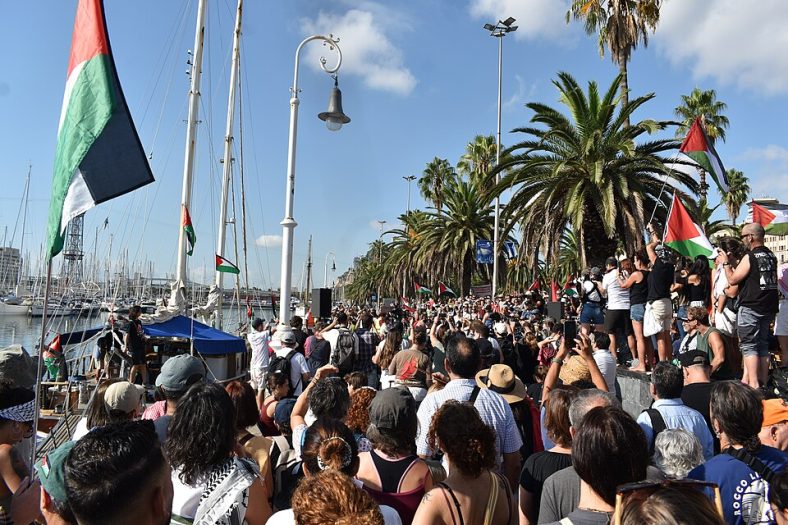
On 19 May, the US Department of the Treasury's Office of Foreign Assets Control (OFAC) published a Press release in which it stated that it had taken “measures against four individuals associated with the pro-Hamas flotilla organised by the Popular Conference of Palestinians Abroad (PCPA), which is attempting to enter Gaza in support of Hamas”. The OFAC statement in question has issued a new package of sanctions against the four people affiliated with the flotilla heading to Gaza, among whom is also Saif Hashim Kamel Abukishek, a Spanish member of the Popular Conference for Palestinians Abroad and spokesperson for the Global Sumud Flotilla, whose inclusion on the blacklist occurred precisely as a result of his abduction in international waters – off the coast of Greece – by the Zionist entity.
In parallel, on June 3rd, Israel released A report by the Israeli Ministry for Diaspora Affairs which accuses four Spanish NGOs of diverting funds to Palestinian organisations. Among these is En route to Gaza, the Spanish delegation of the Freedom Flotilla Coalition. The Israeli report indicates over 40 organisations operating in the UK, France, Spain and the Netherlands, which would have raised funds through platforms Crowdfunding, bank transfers and various payment and cryptocurrency applications, masking it all as humanitarian aid and charitable donations.
The two documents – a US OFAC statement on the one hand, and an Israeli report on the other – refer to the same structures (Popular Front for the Liberation of Palestine/Samidoun, Popular Conference for Palestinians Abroad, Flotilla) but they do not merely overlap, they complement each other: the difference being that while the US targets individual figures, Israel targets organisations. Both cite the Flotilla as a point of convergence, both physical and symbolic: the knot that holds together the networks they want to strike.
Spain in the spotlight
Due documenti che parlano delle stesse reti e della stessa Flotilla. Non è una coincidenza: Difficile non pensare, perciò, che si tratti di una campagna coordinata tra Israele e USA per criminalizzare il sostegno alla Palestina in Europa. Una campagna che vede in particolare la Spagna nel mirino. Anche questa non è una coincidenza: sin dal riconoscimento dello Stato palestinese e il sostegno alla causa davanti alla Corte Inter Milan di Giustizia, il governo Sánchez si è posto come una spina nel fianco per Israele e per l’amministrazione Trump. Accusare le ONG spagnole significa mandare un messaggio al governo, non solo alle associazioni. Lo stesso rapporto israeliano lo ammette esplicitamente, definendo la Spagna una “base conveniente” per le attività delle organizzazioni pro-palestinesi.
In Italia, invece, nonostante l’assenza di un report ufficiale israeliano a darne il via, è stata la magistratura locale – la Procura della Repubblica di Genova – ad avviare in autonomia l’inchiesta. Dalle indagini sui Alleged funding of Hamas the arrests of several activists, including Mohammad Hannoun, president of the Association of Palestinians in Italy, followed, in December 2025.
Manufactured and specious connections
Both the OFAC statement and the Israeli report They do not present evidence of direct financing for military operations., but they cast suspicion on the chains of connection: in the case of NGOs, for example, they are accused of funding entities that, in turn, fund other organisations.
The Israeli report cites, for example, the Spanish branch of the British NGO Human Appeal, which was already outlawed in Israel in 2008 for alleged financial ties to the Union of Good, defined as the main channeler of charitable funds to Hamas.
The Flotilla, however, is attacked through the Spanish delegation of the Freedom Flotilla Coalition – En route to Gaza – and its operator, Unadikum. In this case, Israel links the organisation's founders, former MEP Manu Pineda and activist Daniel Lobato, to key figures such as Ismail Haniyeh (political leader of Hamas, assassinated by Israel), the Iranian television network HispanTV, and the Turkish NGO IHH. Israel considers the latter a terrorist organisation due to its links with the aforementioned Union of Good.
However, these claims do not hold up even to superficial analysis: Daniel Lobato is neither a founder nor a member of Unadikum, and the alleged connections with Haniyeh, HispanTV and IHH are likewise devoid of any factual basis. The accusation is therefore based on arbitrary attributions, with no verification from financial flows or any other type of legally relevant link.
If you are in Gaza, you are “Hamas”
A third organisation – Peace with Dignity – is said to have transferred 759,510 euros to the Gaza hospital complex before August 2025 Al-Awda. The nature of the accusation, in this case, lies in the definition of Al-AwdaThe report describes it as the “healthcare arm of Hamas”, despite it being known as the only secular and independent hospital in the Gaza Strip: funding for a healthcare entity is automatically equated with support for the war machine.
Finally, the most striking example of association logic is that of the’Al-Quds Associationthe accusation arises from the fact that the director of one of the entities receiving funds from Al Quds, the Palestinian Centre for Human Rights (PCHR) was convicted by an Israeli court for belonging to Hamas. No figure for diverted money, nor any specific armed act, is cited; the mere connection with a convicted individual – by courts known, moreover, for the arbitrariness with which they judge Palestinians – is sufficient to incriminate the entire solidarity organisation.
In addition to the indirect nature of the evidence, the report criminalises an operational aspect: unlike other European countries which rely on Crowdfunding, the Spanish NGOs accused predominantly use credit cards, bank transfers, and payment apps such as Bizum o PayPal. Paradoxically, this traceability is used to accuse Spain of being a convenient base for the activities of pro-Palestinian organisations, both for fundraising and for promoting anti-Israeli viewpoints. The normality and regularity of financial transactions become an element of suspicion.
In essence, the Israeli report does not conceal the political motivation behind it. It explicitly states that Pedro Sánchez's government has made Spain a base for the activities of the pro-Palestinian movement; it admits the absence of concrete evidence, basing its accusations on alleged managerial opacity – but argues it using transparent fundraising tools (!) – and on a network of associations that, while politically unwelcome, do not present any direct link to terrorist activities: “The findings indicate a significant gap in transparency,” the report reads. “Although the public can view the donation campaign and payment methods, in most cases it cannot know how the money is transferred, who the intermediaries are, and what its final destination is within the Gaza Strip.” Uncertainty and the complexity of solidarity networks are therefore criminalised. To get to the heart of the matter, Israel considers it proof of guilt that Israel itself does not control, down to the last penny, where the money ends up.
The four accused organisations have responded with a joint statement, rejecting the accusations as lacking any evidential basis, be it documentary, judicial, administrative or financial. They claim not to have received any request for a hearing from Israel or the media who spread the accusations, highlighting how the uncritical reproduction of such serious claims by agencies and newspapers constitutes an element of the campaign of Lawfare.
The short circuit in the US-Israel axis
A little attention is all that's needed to uncover sharp contradictions in this merry-go-round of accusations. For example, the US Treasury Department's statement sanctioning the organisers of the Flotilla refers to the “Supplementary guidelines for the provision of humanitarian assistance”issued in 2023 by OFAC itself. These guidelines explicitly recognise certain principles that contradict the logic used by both the USA and Israel to sanction Abukishek and others.
The first principle concerns funds that inadvertently reach members of sanctioned groups. The OFAC admits that “in dangerous and unstable environments, some humanitarian aid may inadvertently fall into the hands of members of a sanctioned group” and that “such incidental benefits are not subject to enforcement“, or rather, they cannot be prosecuted. It is precisely the indirect chain used against Al Quds, in which the funds of the Malaga association Peace with Dignity they reach the PCHR, which operates in a Hamas-controlled Gaza Strip. According to the same US Treasury rules, this does not constitute a violation.
The second principle is even more direct: non-US NGOs do not risk US sanctions for facilitating transactions that fall under authorised humanitarian categories. “Non-U.S. persons, including NGOs and other entities, as well as foreign financial institutions, that facilitate or assist such activities are not at risk of U.S. sanctions exposure.” This automatically dismisses all accusations against Spanish organisations; meanwhile, the sanctions against Abukishek, targeting him as an individual, circumvent this principle to expose the entire Flotilla as a “pro-Hamas” organisation.
The third principle states that “in some cases, one or more executives of an entity may have been sanctioned by OFAC, but the entity as a whole has not been sanctioned” and that “an entity commanded or controlled by an OFAC-sanctioned individual is not considered blocked by operation of law.” The director of the PCHR, reportedly linked to Al Quds hospital, was convicted – by an Israeli court, not sanctioned by OFAC – and the PCHR itself does not appear on any US blacklist. The Israeli accusation against Al Quds therefore does not hold up, even when applying the criteria of its own ally.
If the American and Israeli accusations against Spanish NGOs falter on the same US guidelines, in the case of Italy, it is precisely the evidence that proves fragile when based on data collected in war contexts. process a Hannoun, The Italian Court of Cassation has indeed annulled the order which confirmed the pre-trial detention, deeming the initial evidence inadequate: it consisted of battlefield evidence, or rather generic material gathered from’Israeli army in the occupied territories, lacking independent verification and not substantiated by impartial third parties. The Court of Cassation therefore deemed such documents impossible to investigate – as they were too generic in nature – and insufficient to confirm the pre-trial detention without independent verification. Subsequently, on 19 June 2026, a new order from the Review Court of Genoa He has since reconfirmed the pre-trial detention for Hannoun and the other activists, based on a document from the Association of Palestinians in Italy concerning the distant adoption of 21 orphans, children of martyrs from the Al-Qassam Brigades. The prosecution argues that such financial support is not an act of solidarity but an intervention aimed at “ensuring continuity and prestige for the military path within the Brigades, which represent the armed wing of Hamas.” The defence, however, has demonstrated how, during the same period, the association adopted over a thousand Palestinian orphans, thus proving a general humanitarian purpose and not one solely aimed at the relatives of the martyrs. This process shows that, while in Spain the mechanism stops at the political-diplomatic level due to a lack of local judicial evidence, in Italy the system proceeds, although the quality of the evidence provided appears compromised by its nature as war intelligence gathered unilaterally, without any independent and impartial investigation.
Who decides what terrorism is, and why is it important to know?
La definizione di cosa significa finanziare “il terrorismo”, alla base di entrambi i documenti non è universale né neutrale; si tratta di una definizione arbitraria fornita da USA e Israele. Il power politico, economico e soprattutto militare di queste due entità è ciò che permette loro di decidere quali organizzazioni armate siano resistance e quali terrorismo, quali ospedali siano infrastrutture civili e quali nascondigli militari. Per esempio, il PCHR – l’organizzazione che lega Al Quds all’accusa di finanziamento del terrorismo – è accreditato presso le Nazioni Unite e collabora attivamente con la Corte Penale Internazionale (CPI). Il fatto che un tribunale israeliano abbia condannato il suo direttore dimostra ben poco; non bisogna dimenticare che Israele è lo stesso soggetto che ha bombardato gli ospedali che questa ONG finanziava, lo stesso contro i cui vertici la CPI ha emesso mandati di arresto per crimini di guerra e crimini contro l’umanità, lo stesso che tiene in detenzione da 18 mesi il dottor Husseim Abu Safiya, direttore dell’ospedale Kamal Adwan, senza alcuna accusa.
In a legal system, the answer to the question of who has the legitimacy to define terrorism should receive an answer first to be able to issue sanctions that punish so-called terrorists. But in the reality of current international relations, things are very different. The Lawfare – that is to say, warfare conducted through the instrumental use of law and judicial procedures – aims to discourage. To ensure that organising, participating in the Flotilla, or financing a hospital in Gaza become actions that expose one to unpredictable consequences (blacklists, blocked accounts, destroyed reputations).
It is worth noting that the Israeli report was not published on the Ministry's official website, where similar documents are usually made available to the public. It was only selectively leaked to some media outlets. This choice is consistent with the logic of the entire document: in this case – unlike what happened in Italy with the indictment of Mohammad Hannoun and other Palestinians – the aim is not to build a legal case, but to spread an accusation. The purpose is entirely political: to target Spain. A government that recognises Palestine, that supports ICC proceedings, that hosts the most active solidarity movement in Europe, is a political problem. Criminalising its networks, one NGO at a time, one activist at a time, is imperative for Israel.
Confirming that this is a case of political pressure is a fact that the organisations themselves highlight in their joint statement: none of them has ever faced formal charges or sanctions from the Spanish judicial authorities, nor have they been the subject of any administrative or financial proceedings that would substantiate the allegations that have been circulating. In Italy, however, whilst awaiting the outcome of the legal proceedings concerning the aforementioned Hannoun case, a legal basis has been found. Two different paths, with the same aim: to discourage mobilisation and block solidarity with Gaza.
This is a message for anyone in Europe who is considering continuing to support the struggle for the liberation of Palestine: don't do it, you could pay dearly for the consequences.
© Kritica – Partial reproduction allowed (no more than half an article) by including the link and citing the source at the beginning.